
The Rushmore Method:
Hotel Franchise Negotiations & Brand Selection
"The Course That Walks You Through All 136 Negotiable Provisions in a Hotel Franchise Agreement."
Click Here to Register for Hotel Franchise Negotiations & Brand Selection Course
Make smarter brand decisions and negotiate franchise agreements that protect your investment. This course covers the complete franchise lifecycle -- from defining your goals and analyzing competitive markets, to underwriting the real economics of brand affiliation, to negotiating the terms that matter most.
WHAT YOU'LL LEARN
- How to define ownership goals and match them to the right brand
- Competitive analysis and brand shortlisting methodology
- Underwriting real economics -- RevPAR lift vs. fee stack vs. PIP capital
- Negotiating business terms, transfer rights, and exit provisions
- Data, technology, and cyber risk provisions in modern franchise agreements
CERTIFICATION
Upon completion, earn the Certified Hotel Franchise Negotiator (CHFN) designation.
WHO SHOULD TAKE THIS COURSE
This course is designed for both hotel professionals and newcomers to the industry who want to advance their careers in hotel consulting, appraisal, asset management, revenue management, operations, brokerage, lending, and ownership.
Whether you're developing a new hotel, evaluating a potential acquisition, underwriting a hotel loan, preparing for negotiations, or building a career in hotel consulting, The Rushmore Method gives you the methodology and certifications used by professionals worldwide.
Price: $995 | Monthly Payment Plan Available| Full Money Back Guarantee if not 100% Satisfied| Let's talk: [email protected]
LEARN DIRECTLY FROM STEVE RUSHMORE:
Steve is available at any time to discuss your career goals either via email or Zoom call. Reach out to him now: [email protected]
Steve will take you step-by-step through the process of selecting a hotel brand and negotiating the franchise agreement- revealing his thought process for making all the necessary decisions to properly perform a brand search and prepare for intense franchise negotiations.
What is unique about this online course? Steve will personally assist you throughout the course via email and Zoom calls. You will interact and learn directly from the Founder of HVS and creator of The Rushmore Method: Franchise Negotiations and Brand Selection. Many of Steve’s students go on to become his mentees, gaining the benefit of his 40+ years of career guidance along with access to his extensive industry network.
WHAT STUDENTS SAY ABOUT STEVE RUSHMORE'S COURSES
"I recently started your franchise negotiation course and have been thoroughly enjoying it—not only the content itself, but also the way it is structured. The fundamentals of how to select a brand are very easy to follow, and each module connects seamlessly as I progress through the course.
I strongly agree with your point that brand selection should not be driven solely by the owner’s preference but should also be supported by market data and performance metrics and aligned with the owner’s long-term goals. I believe this principle applies equally to both franchise and direct management contracts."
-- Wenxin Li, Marriott Hotels & Resorts- China
"I credit my career progression and continued success in large part to Steve Rushmore and the knowledge I have gained."
-- Sebastian Villa, hotelAVE
"Very insightful and practical, providing valuable knowledge that I can apply directly in my role. The relevance of the material to real-life applications, the detail of the content, and access to Steve Rushmore's experience were exceptional."
-- Mustafa Rahmatono, Colliers
"It was a rewarding experience to learn from Steve Rushmore, founder of a global hotel consulting organization."
-- Marjorie D.
MORE DETAILS ABOUT THE RUSHMORE METHOD: HOTEL FRANCHISE NEGOTIATIONS & BRAND SELECTION
This course gives you a major advantage because franchise decisions often appear simple on the surface but have deep, long-term consequences. Many hotel owners choose a brand based on name recognition and the promise of demand, only to discover later that the franchise agreement imposes layers of costs, mandates, and restrictions that reduce NOI and constrain strategic options. This course teaches you how to avoid that outcome by learning to evaluate brands as a sophisticated owner or advisor would.
Some of the valuable lessons you will learn include:
- How to choose the right flag by analyzing market fit, segment alignment, and the way brand strength varies by location and customer type.
- How to evaluate the real role of distribution systems and loyalty programs, to distinguish between perceived brand contribution and actual economic benefit, and to understand how brand standards and mandatory programs affect both the guest experience and the cost structure.
- The negotiation section of the course teaches you how to approach the franchise agreement as a business negotiation that can improve profitability and preserve flexibility.
- How to evaluate the full cost of affiliation, including the combined impact of royalties, marketing charges, reservation and loyalty costs, technology participation requirements, and ongoing compliance fees that can quietly accumulate into a meaningful reduction in NOI.
- How to negotiate improvement obligations and reduce exposure to surprise property improvement requirements by insisting on clarity, realistic timing, and flexibility that matches the asset’s physical condition and investment plan.
- How territory and brand growth decisions can affect your hotel’s demand, and how to seek meaningful safeguards and disclosure to reduce cannibalization risk.
- How operating mandates, vendor rules, purchasing constraints, required programs, staffing and service expectations, and technology systems, can raise operating costs, and how to negotiate for practical, fair requirements that do not undermine the owner’s economics.
- How inspections and enforcement really work, how to negotiate objective standards and reasonable cure processes, and how to protect the owner from shifting requirements that create unpredictable risk.
- How transfer, change-of-control, renewal, and termination provisions can either preserve or restrict liquidity, and how to negotiate terms that support the owner’s ability to sell, refinance, reposition, or change strategy as the market evolves.
Completing the course earns the Certified Hotel Franchise Negotiator (CHFN) designation, signaling that you can evaluate brands and negotiate franchise agreements with an owner-first mindset that employers and clients immediately recognize as valuable.
Ideal, not only hotel owners, but hotel consultants, appraisers, attorneys, and students pursuing careers in hospitality ownership or advisory roles, this course demystifies one of the most least understood and complex agreements in the hotel industry. While franchise agreements are essential to aligning the interests of owners and brands, they often tilt in favor of the hotel company, especially when negotiated without a thorough understanding of the risks, nuances, and leverage points available to owners.
Through engaging online video lessons, real-world examples, and analysis of actual franchise provisions you’ll learn how to:
- Identify and negotiate the key contract provisions that most affect owners’ rights and financial returns, and learn how to make them part of your contract.
- Understand the implications of the franchise fee stack that includes hidden fees that are imposed during the contract term.
- Protect against long-term inflexible commitments and one-sided termination clauses.
- Use brand leverage, market data, and ownership structure to improve your negotiating position.
- Ensure quiet enjoyment, owner flexibility, and clear exit strategies under a variety of scenarios.
- Structure the brand search process to find the most appropriate affiliation that meets the owner's investment requirements.
This is the most in-depth course on hotel brand selection and franchises available anywhere. It contains a thorough discussion of hundreds of franchise provisions, negotiating strategies, risk analyses, and franchisor search procedures.
The cost for The Rushmore Method: Hotel Franchise Negotiations & Brand Selection course is $995, which includes the following:
Access to the course
- Start at any time and proceed at your own pace.
- Unlimited downloads of sample franchise agreements, franchise disclosure documents (FDD), articles, and publications.
- One-on-one Zoom calls with Steve Rushmore.
- Upon completion of the course and a passing final exam, you will receive the Certified Hotel Franchise Negotiator certificate (via e-mail) suitable for framing.
- Your name will appear in the Directory of Certified Hotel Franchise Negotiators.
The course includes over 30 hours of content, featuring instructional videos, readings, case studies, and franchise agreements. The curriculum is vast, covering over 400 key topics, along with clear recommendations on how to structure and negotiate each franchise provision to protect the owner’s interests.
Become a Certified Hotel Franchisor Negotiator
By successfully completing the course and passing the final exam, you will receive the Certified Hotel Franchise Negotiator certification, which sets you apart from other industry professionals.
Take My Course And Your Name Can Be On This Certificate
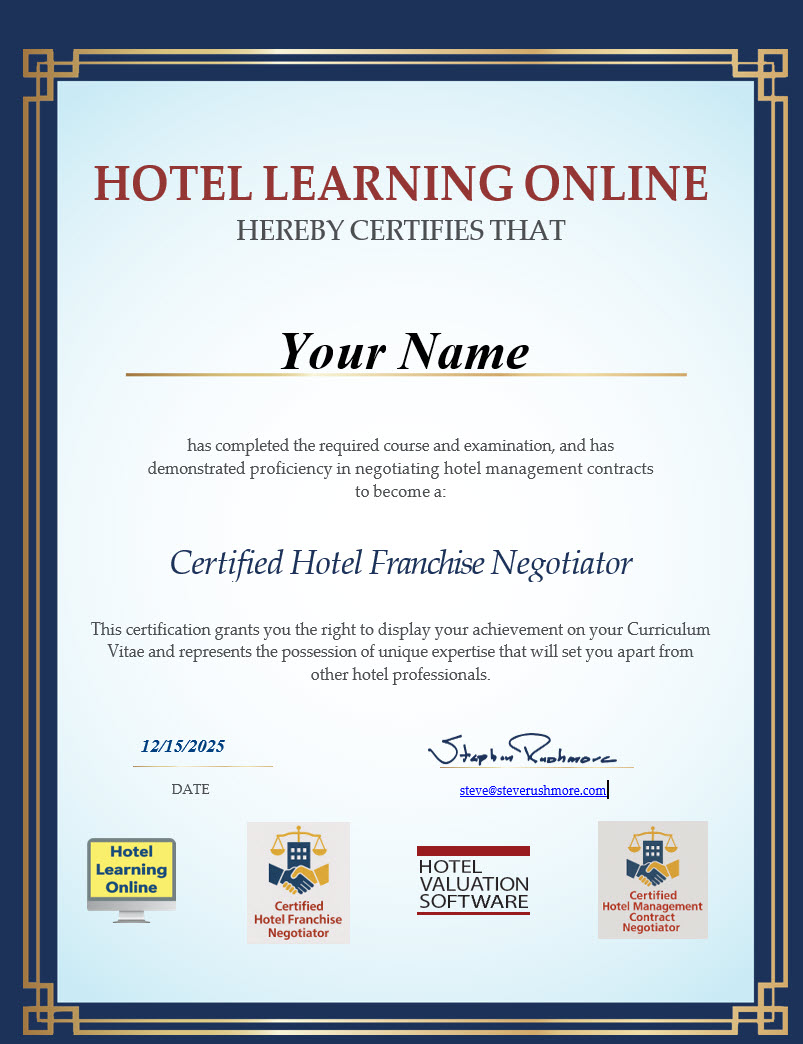
Table of Contents: The Rushmore Method: Hotel Franchise Negotiations & Brand Selection
Click on the Link to download a copy of the Table of Contents showing the extensive content of this course.
Table of Contents The Owner’s Guide to Hotel Brand Selection & Franchise Negotiation v2.pdf
Steve Rushmore
Founder of HVS

Steve Rushmore, MAI, CHA is the Founder of HVS- a global hotel consulting organization with more than 50 offices around the world. He has provided consultation services for more than 15,000 hotels during his 50-year career and specializes in complex issues involving hotel management contracts, valuations, feasibility, and financing.
As a leading authority and prolific author on the topic of hotel investments, Steve has written all five hotel valuation textbooks and two seminars for the Appraisal Institute and is known as the “Creator of the Hotel Valuation Methodology.” He has also authored three reference books on hotel investing and has published more than 300 articles. Steve developed the Hotel Market Analysis & Valuation Software used by HVS and thousands of hotel appraisers/consultants, owners, and lenders throughout the world.
Steve lectures extensively on hotel investing and management contracts and has taught hundreds of classes and seminars to more than 20,000 industry professionals. He is also a frequent lecturer at major hotel schools and universities including Cornell, Glion, Hong Kong Polytechnic, EHL, Florida International University, IMHI, Michigan State, Penn State, Kennesaw, Houston, NYU, and the Harvard Business School.
Steve’s most recent contribution to hotel education are his three online courses:
- The Rushmore Method: Hotel Valuation, Market and Investment Analysis
- The Rushmore Method: Hotel Management Contracts: Operator Search & Contract Negotiations
- The Rushmore Method: Hotel Franchise Negotiations & Brand Selection
Click Here for More Information on Steve's Courses
Steve has a BS degree from the Cornell Hotel School, an MBA from the University of Buffalo, and attended the OPM program at the Harvard Business School. He held the MAI and FRICS appraisal designations and is a CHA (certified hotel administrator). In his free time, Steve enjoys tennis, skiing, hiking, diving, sailing, and cooking with his wife (who is a trained Chef). He holds a commercial pilot’s license with instrument, multi-engine, and seaplane ratings.
See What Steve's Students Say About His Courses
- Working directly with Steve was the highlight; his feedback was specific and immediately useful. I felt like I had a real mentor.
- Steve’s real-world examples connected every lesson to how deals actually work.
- Direct access to Steve made the course feel personal. His insights on market realities added depth you can’t get from other courses.
- Steve was generous with his time and expertise and made sure I truly understood the “why” behind each step. We made several Zoom calls together, which were amazing.
- Steve took me as his mentee and helped me develop my career path.
- The lessons taught me how to evaluate decisions from an owner’s perspective, which is essential in asset management. I’m finally ready to pursue interviews in the field.
- I understand hotel operations, but not value. This course bridged that gap. It gave me a professional method to assess opportunities and risks.
- This course gave me a credible foundation to move from operations into the investment side. I finally understand how decisions translate into value.
- I used the process to complete a full market and valuation analysis, end-to-end. That final project became a strong portfolio piece for consulting employment applications.
- The course gave me a better grasp of cap rates, cash flow, and market positioning. That foundation will help me succeed in brokerage.
- The course gave me a structured way to understand my market and my property’s competitive position.
- The Certified Hotel Valuer certification helped me stand out in my interviews.
- This certification supports my transition from operations into a more analytical role.
- The depth of the course material exceeded my expectations; it was still organized and easy to follow.
- I appreciated how the course covered both the “how” and the “why.”
- The operator search framework gave me a clear, step-by-step process to identify the right partners.
- The negotiation playbook was incredibly practical, with clear priorities, fallback positions, and language that protects the owner. I feel prepared for real negotiations now.
- I used the checklists to review a draft agreement clause-by-clause. It turned a confusing document into a manageable negotiation.
- The process helped me pick a brand that fits my property’s story and my market’s demand profile. I now feel certain about my direction.
- The franchise negotiation lessons showed me where the real leverage points are: fees, term, and property improvement requirements.
- The negotiation strategy taught me how to prioritize “must-haves” versus “nice-to-haves.” That made my discussions efficient and confident.
Course Curriculum
The Rushmore Method: Hotel Franchise Negotiations & Brand Selection: Click on the down arrows to see the extensive content of each chapter.
-
1
Course Introduction
-
Navigating the Course Platform
-
Introduction to Steve and His Avatars
-
Student Enrollment Survey- Introduction
-
Student Enrollment Survey
-
How to Select a Hotel Brand and Negotiate the Franchise Flow Chart
-
How to Use the Table of Contents
-
Table of Contents- Detailed Outline of the Course Content
-
-
2
1. Hotel Brand (Franchise) Search Process
-
1A Hotel Brand (Franchise) Search Process
-
1B Step-by-step Guide to Selecting a Hotel Brand and Negotiating the Franchise
-
-
3
2. Define Ownership Goals and Strategic Objectives
-
2. Define Ownership Goals and Strategic Objectives
-
-
4
3. Conduct a Market Analysis
-
3A. Market Fundamentals & Demand Drivers
-
3B. Competitive Set & Market Conclusions
-
3C. Consumer Positioning & Their Brand Choice
-
3D. Brand Standards, Prototype & Design Approval
-
-
5
4. Identify Suitable Brand Segments
-
4A. Build Your Brand Shortlist Flags and Structures- Identify Suitable Brands
-
4B. The Process of Identifying Suitable Hotel Brands
-
4C. Qualitative Scoring Framework for Selecting a Hotel Brand
-
4D. Franchise vs. Brand-Managed vs. Independent
-
4E. Soft Brand vs Hard Brand
-
4F. Brand Descriptions for Selecting the Best Brand
-
4F1. How to Use Brand Descriptions
-
4F2. Brand Descriptions for ACCOR Group
-
4F3. Brand Descriptions for BWH Hotels
-
4F4. Brand Descriptions for Choice Hotels
-
4F5. Brand Descriptions for Hilton Hotels & Resorts
-
4F6. Brand Descriptions for Hyatt Hotels and Resorts
-
4F7. Brand Descriptions for InterContinental Hotels and Resorts
-
4F8. Brand Descriptions for Marriott Hotels & Resorts
-
4F9. Brand Descriptions for Wyndham Hotels & Resorts
-
-
6
5. Franchise Decision Framework
-
5A. Franchise Disclosure Document (FDD)- Part 1
-
5A-1. Sample Franchise Disclosure Documents
-
5B. Franchise Disclosure Document (FDD)- Part 2
-
5C. Hidden Costs Not Obvious in the FDD
-
5D. Understanding PIP Realities
-
-
7
6. Financial & Feasibility Analysis
-
6A. Economic Analysis For Brand Selection
-
6B. Apply the Analysis to Real Brands
-
6C. Reservation Contribution & Channel Economics
-
6D. Reservation Contribution & Channel Economics (Continued)
-
6E. Operating Model & Staffing Feasibility
-
-
8
7. Evaluate Brand Strength and Support
-
7A. Evaluate Brand Strength and Support
-
7B. Pipeline & Brand Saturation Analysis
-
7C. Understanding the New Traveler Types
-
7D. Future Trends in Branding & Franchising- Part 1
-
7E. Future Trends in Branding & Franchising- Part 2
-
-
9
8. Data Rights & the Guest Relationship
-
8A. Data Rights & the Guest Relationship
-
8B. Technology Roadmap & Cybersecurity- Part 1
-
8C. Technology Roadmap & Cybersecurity- Part 2
-
-
10
9. Lender Perspective on Branding & Franchises
-
9A. Lender Perspective on Branding & Franchises
-
-
11
10. Negotiate Key Business Terms
-
10A. Negotiate Key Business Terms
-
10A1. Rushmore Checklist: Franchise Clauses Owners Should Prioritize
-
10B. Franchise Agreement- Clause-by-Clause
-
10C. Franchise Agreement Addenda & Side Letters
-
10D. The Actual Negotiation Process
-
Deal Items What to Negotiate
-
List of Non-Negotiables Franchise Business Terms
-
The Opening Offer and Ultimate Fallback Positions
-
The Opening Offer and Fallback Position for a Deal-Specific Negotiations
-
Ask Grid: Upscale New-Build Hotel
-
Franchise Negotiation Script Brand Pushback Owner Response
-
-
12
11. Interview Existing Franchisees
-
11. Interview Existing Franchisees
-
-
13
12. Obtain Brand Approval and Submit Application
-
12. Approval to Signature Process, Timeline, and Leverage
-
-
14
13. Finalize and Execute Franchise Agreement
-
13A. Finalize and Execute Franchise Agreement
-
13B. Where Each Negotiated Point Must Live
-
-
15
14. Overview of the Entire Franchise Selection Process
-
14A. Step-by-step Guide to Selecting a Hotel Franchise
-
14B. A Checklist of What Needs to be Done to Perform a Hotel Brand Selection & Franchise Negotiation
-
14C. Hotel Brand Selection & Franchise Workbook
-
14D. Student Handout - Integrated Process for Brand Choice and Franchise Agreement Negotiation
-
-
16
15. Brand Governance & Dispute Escalation Mechanics
-
15. Brand Governance & Dispute Escalation Mechanics
-
-
17
Appendix
-
Key Money- Franchisor's Investment in the Property
-
International Differences in Franchising
-
Articles on Hotel Brands, Franchising, Franchises- Old and New
-
-
18
Learning Summary
-
Introduction to the Learning Summary
-
Learning Summary
-
-
19
Thank You For Taking My Course
-
Thank You For Taking My Course
-
-
20
Post Course Survey
-
Post Course Survey- Introduction
-
Post Course Survey- Please complete this Survey and give us feedback on your experience with this course.
-
Steve Rushmore's Online Courses
Learn the Skills That Separate You From the Crowd in Hospitality Real Estate
In the hotel business, value is created and protected in two ways: through sound investment analysis and through negotiated agreements that determine the hotel’s long-term economics, control, and flexibility. The most attractive professional opportunities in hospitality—hotel asset management, acquisitions, development, valuation, consulting, and owner/operator advisory—require both. Steve Rushmore’s online courses were created to train students and professionals in this owner-first toolkit, using practical, real-world methods that mirror how decisions are made on actual deals.
Course #1: Hotel Market Analysis & Valuation provides the analytical foundation for investment decisions and professional advisory work. Students learn how to perform a structured hotel market analysis that goes beyond surface-level observations and produces conclusions a lender, investor, or investment committee can rely on. The course teaches how to define and evaluate a competitive set, interpret supply and pipeline risk, understand demand generators, and translate market intelligence into a clear positioning strategy. Students then learn to forecast occupancy and ADR using disciplined logic, not guesswork, and to build a set of financial projections that connect the market story to revenues, expenses, and NOI. The valuation section teaches how professional hotel valuers reach conclusions using recognized methodologies, including discounted cash flow concepts and the mortgage-equity framework, supported by transaction evidence and cost benchmarks where appropriate. By the end of the course, students can read a market, build defensible projections, understand value drivers, and communicate conclusions in a way that supports financing, acquisition, disposition, development, renovation, partnership structuring, or advisory assignments. Successful completion earns the Certified Hotel Appraiser (CHA) or Certified Hotel Valuer (CHV) designation, signaling that the graduate can perform hotel market studies and valuations with professional competency.
Course #2: Selecting a Hotel Operator and Negotiating the Management Contract addresses the reality that management agreements are not simply legal documents; they are operational and financial control systems that can determine an owner’s results for years. The course teaches a complete method to select an operator and negotiate a management agreement from the owner’s perspective. Students learn how owners and advisors structure an operator search, define objectives and success criteria, and identify candidates that match the property’s positioning and the owner’s long-term strategy. The course then explains how to compare operator proposals intelligently, including understanding what different fee structures and incentive designs can mean in practice, and how operator commitments, staffing plans, brand affiliations, reporting standards, and capital planning philosophies affect outcomes. The negotiation portion focuses on the provisions that most influence profitability and control, including fee structures, performance tests and enforceability, cure rights, termination provisions, term and renewals, owner approvals over budgets and capital expenditures, key staffing and vendor decisions, transparency and reporting, audit rights, and remedies that actually work when performance fails to meet expectations. Students learn how to think in terms of leverage, priorities, fallback positions, and the owner’s best alternatives, so negotiation becomes a structured process rather than a reactive conversation. Graduates earn the Certified Hotel Management Contract Negotiator credential, demonstrating practical ability to evaluate operators and negotiate owner-protective contract terms.
Course #3 (Newest): Selecting a Hotel Brand and Negotiating the Franchise Agreement expands the same owner-first deal framework into a decision area that is often underestimated but deeply consequential. A franchise agreement can shape a hotel’s economics and strategic flexibility for years because it defines the total cost of affiliation, the required standards and programs, the capital and renovation obligations that may be imposed during the term, the distribution and technology requirements that affect profitability, the inspection and enforcement regime that governs compliance, and the transfer, renewal, and termination provisions that can either preserve or impair liquidity. This course begins with brand selection and teaches how to evaluate brands as business partners, not as marketing names. Students learn how to assess whether a brand fits the market and the property’s positioning, how brand strength can vary dramatically by location and demand segment, and how brand choice can influence rate potential, penetration, and demand mix. The course trains students to evaluate the real impact of reservation systems and loyalty programs, and to distinguish between perceived brand contribution and measurable economic benefit. Students also learn how brand standards and mandatory programs can affect labor, service delivery, and operating costs, and how to assess whether those requirements are aligned with the asset’s strategy and return objectives.
The negotiation portion teaches students how to treat the franchise agreement as a business negotiation that directly affects NOI and long-term options, rather than a “take-it-or-leave-it” form. Students learn how to evaluate the full fee structure and the total cost burden over time, including charges that may be presented separately but combine to create a meaningful drag on profitability. They learn how to negotiate improvement obligations and reduce exposure to surprise property improvement requirements by clarifying scope, timing, and flexibility, and by aligning renovation demands with realistic operating conditions and investment returns. The course addresses competitive and territory issues, including how to protect a hotel from nearby cannibalization and how to obtain meaningful safeguards when exclusivity is limited. Students learn to evaluate and negotiate operating constraints such as required vendors, purchasing rules, technology participation, and mandatory programs that may increase costs without producing proportional revenue lift. The course also covers inspection and enforcement mechanics, teaching how to negotiate objective standards, workable cure processes, reasonable timelines, and fair remedies, so compliance risk is managed rather than unpredictable. Finally, the course emphasizes protecting owner flexibility through transfer, change-of-control, renewal, and termination provisions, because the ability to sell, refinance, reposition, or change strategy without excessive friction is often a major driver of liquidity and value. Successful completion earns the Certified Hotel Franchise Negotiator designation, signaling that the graduate can evaluate brand options and negotiate franchise agreements from an informed, owner-protective perspective.
Together, these three courses form an integrated pathway from analysis to execution. Students gain the rare combination of skills that owners and employers value most: the ability to analyze a hotel’s value, evaluate proposals from partners, and negotiate agreements that determine long-term outcomes. This combination is especially powerful for careers in hotel asset management and consulting, where professionals are expected to protect owner interests, challenge assumptions, and deliver results that improve performance and preserve value across market cycles.
Steve Rushmore's Mentorship Program
Guiding the Next Generation of Hotel Consultants, Valuers, Asset Managers & Owners
 Click on the link to watch Steve as he describes the Steve Rushmore's Mentorship Program
"Your career will accelerate when you have the right mentor.”
The Steve Rushmore Mentorship Program is designed to guide aspiring hotel consultants, valuers, asset managers, and owners with knowledge, career strategy, and access to my global network. Together, we’ll transform ambition into achievement.
Steve Rushmore's Mentorship Brochure
Click on the link below to download the brochure